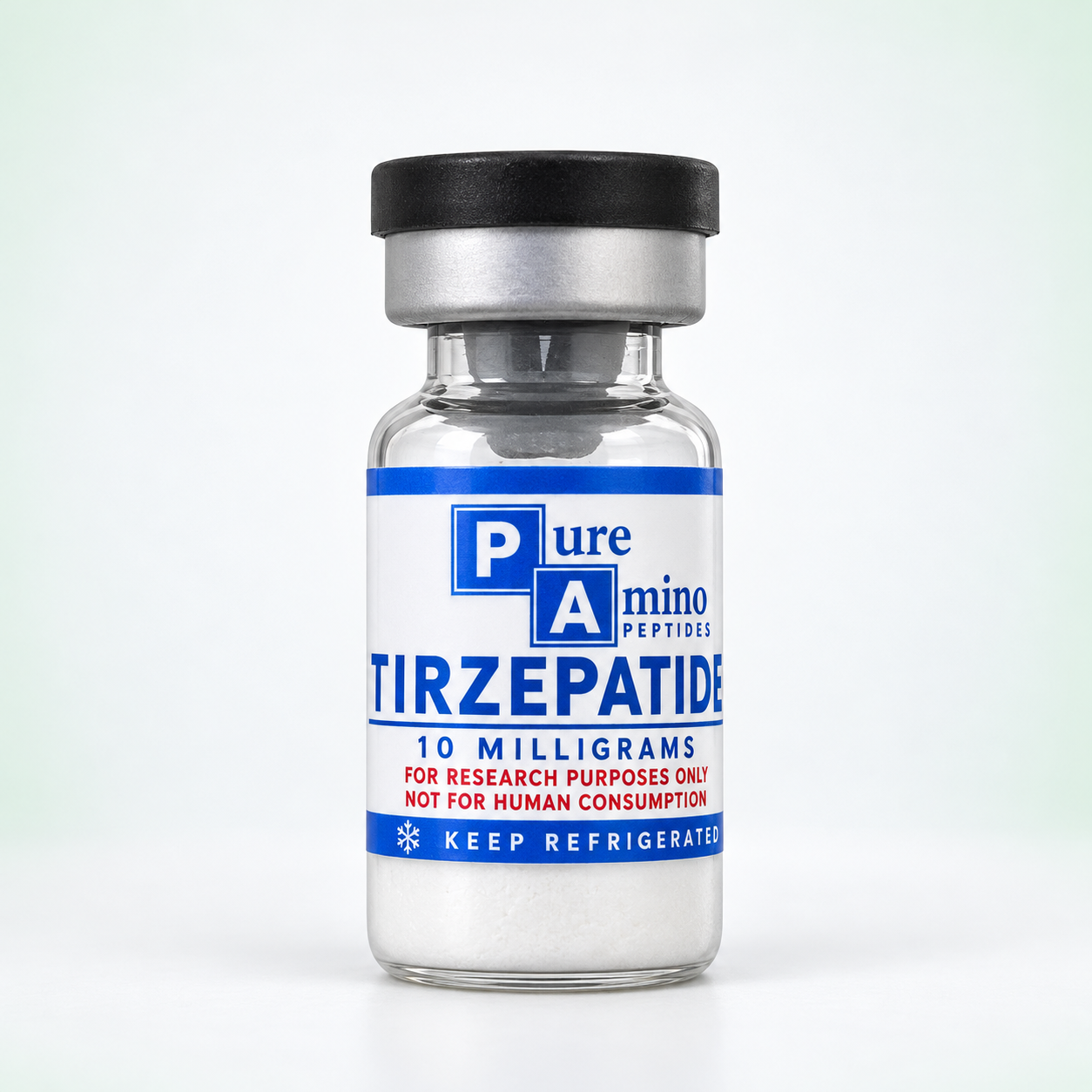
Tirzepatide
10 mg
Select Strength
Research Use Only
For research use only. Not for human consumption. Not intended to diagnose, treat, cure, or prevent any disease. Must be 21 or older to purchase.
Measurement Key
mg = milligram; mcg = microgram; 1 mg = 1,000 mcg. mL = liquid volume. A U-100 syringe has 100 marked volume units per mL: one marking is 0.01 mL and ten are 0.10 mL. These markings are NOT peptide International Units (IU). A physical syringe may not have one-unit or half-unit graduations; do not imply it can measure a value more precisely than its scale permits. Concentration = total amount / measured FINAL volume. Quantity in a sample = concentration × sample volume. Required volume = a protocol-specified quantity / verified concentration. The calculator checks arithmetic only; it cannot select a clinical dose or establish suitability, stability or sterility.
Research Information
Contents
Total tirzepatide powder; not a dose designation. See variant for specific amount.
Clinical evidence and research limitations
Controlled trials of specified tirzepatide formulations support weight reduction in selected adults. They do not establish this research vial's clinical performance.
Dosing evidence
Research-vial dose: not verified. See the prescription reference note below; do not convert that note into customer directions for this powder.
Reconstitution
This is a powder-vial calculation reference, not a validated preparation recipe. Confirm the exact formulation, compatible diluent, final volume, container capacity, mixing method and storage with the manufacturer. Do not interpret the example as a direction to add that volume of BAC water.
Measurement example
MATHEMATICAL EXAMPLE ONLY (10 mg vial): assuming 10 mg in a measured FINAL volume of 2 mL, concentration = 5 mg/mL. One U-100 marking (0.01 mL) represents 50 mcg. Ten U-100 markings (0.10 mL) represent 0.5 mg. For other vial sizes, divide the labeled mg by the measured final volume. These amounts describe the solution; they are not recommended doses.
Possible side effects
Label risks include gastrointestinal symptoms, pancreatitis, gallbladder disease, kidney injury, hypoglycemia and serious allergy. See full prescribing information.
Storage
Follow the original lot-specific supplier instructions before and after preparation. Temperature, light protection, freezing limits and discard date: insufficient data to verify. The calculation volume does not establish stability or a use-by period.
Prescription Reference — Not Instructions for This Research Vial
Zepbound labeling starts at 2.5 mg subcutaneously weekly for four weeks, with increases of 2.5 mg after at least four weeks at a dose. Weight-management maintenance options are 5, 10 or 15 mg weekly; maximum 15 mg weekly. Selection depends on clinical response and tolerability. It is contraindicated with personal/family medullary thyroid carcinoma or MEN2. Its thyroid warning is based on rodent tumors; human relevance is unknown. The research-vial concentration examples are not Zepbound instructions.
Sources
- [S1]Zepbound prescribing information
- [S2]SURMOUNT-1 randomized tirzepatide trial
- [S11]FDA concerns about unapproved GLP-1 drugs
Source access date: October 25, 2026. Secondary calculation references (peptidedosages.com) are community resources, not clinical trials. Their example volumes do not validate these products.
Responding to possible adverse effects: The side-effect summaries are incomplete and do not establish the safety of the inventory. Unknown risks must not be described as "no side effects." For anyone experiencing breathing difficulty, facial/throat swelling, fainting, severe persistent abdominal pain or other severe symptoms after an exposure, seek urgent medical care and provide the product/lot details.
Preparation and Handling Information
The original product instructions must establish substance identity, component ratio, excipients, compatible diluent, required amount, final volume, mixing method, container suitability, storage and discard interval. A 3 mL container does not automatically require 3 mL water. Any powder displacement and final-volume instructions must be accounted for. Do not transfer the storage rules for a branded finished medicine to a different research powder. No universal refrigerated shelf life, freezer shelf life or "28 days after mixing" period is established for this catalog. Lack of visible particles is not proof of sterility. Do not use a damaged, leaking, unexpectedly altered or undocumented preparation.